
Evidence-gated AI · your bid, from watch to won
AI bid writing & the bid workspace
PSIP drafts the first version of your UK public sector bid — executive summary, method statement, win themes, compliance checklist and clarification questions — from the tender’s own requirements and the buyer’s real spending history. Every draft is evidence-gated: it never invents certifications, case studies or figures, and marks anything only you can supply with [INSERT].
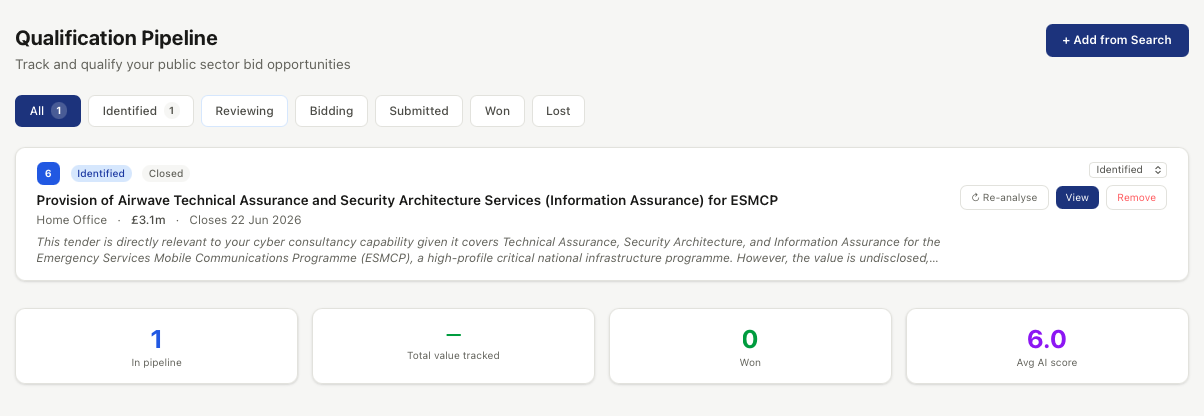
And it all lives in one workspace — a pipeline that carries every opportunity from first sight to submitted, with its deadlines, buyer intelligence and documents attached.
What PSIP drafts for you
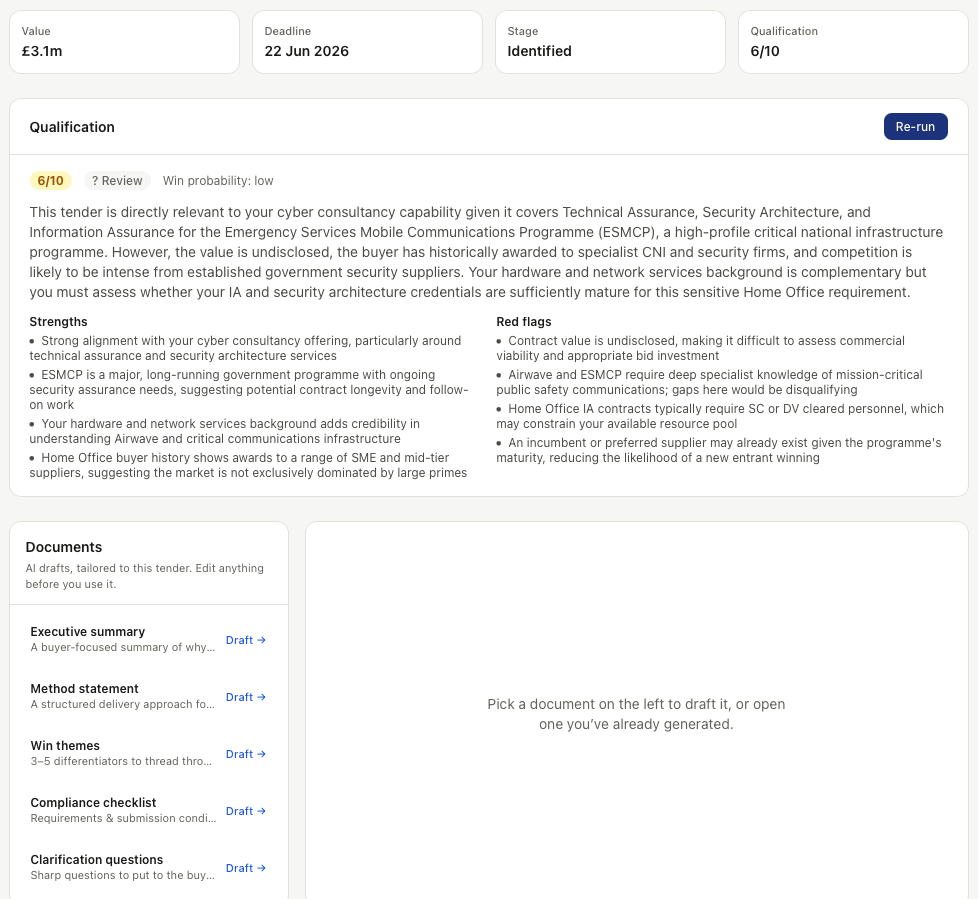
Five documents, aligned to how public sector bids are actually scored.
Executive summary
A buyer-tailored opening that frames why you are the right supplier — drawn from the tender's stated priorities and the buyer's history.
Method statement
A structured technical response mapped to the tender's requirements, so your delivery approach answers what the evaluators actually score.
Win themes
Three to five value propositions positioned against the likely incumbent, built from the buyer and award data already in PSIP.
Compliance checklist
Every mandatory requirement pulled out of the notice into a checklist, so nothing that would disqualify your bid slips through.
Clarification questions
A ready set of questions to put to the buyer before the deadline — seeded from gaps and ambiguities in the tender documents.
Each draft is generated from the tender notice plus the buyer’s award and payment history already in PSIP — then it’s yours to edit, save and submit.
![PSIP AI-drafted method statement open in the editor, showing multiple [INSERT] placeholders marking facts the supplier must provide, alongside the five draftable documents.](/screenshots/bid-workspace-draft-insert.png)
Why “evidence-gated” matters
A general-purpose AI writing tool starts from a blank prompt. Ask it to write a bid and it will fill a gap by inventing a certification, a case study or a number — the fastest way to get disqualified, or worse.
PSIP’s bid AI works the other way. It starts from the real tender notice and the buyer and award data already in the platform, and it is built to flag missing evidence rather than manufacture it.
Anywhere a section needs a fact only you hold, it writes [INSERT: …] and moves on. You always know exactly what still needs your input.
Evidence-gated drafting vs a generic AI chatbot
One workspace, from first sight to won
Every opportunity moves across your board — and carries everything it needs with it.
Qualify with intelligence
A bid/no-bid scorecard assembles the estimated value, the buyer’s past contract awards on record — who won, at what value — and your fit against the requirements, with strengths and red flags called out.
Every deadline on the bid
Clarification and submission dates travel on every bid, so you always know what’s due and when.
Draft in place
Generate any of the five bid documents straight from the opportunity you’re working — no re-keying the tender, no separate tool.
Included on Growth and above
The bid pipeline, the qualification scorecard and evidence-gated AI drafting are all included on Growth (£599/mo), Professional (£1,199/mo), Bid Agency and Enterprise plans.
View all plans →Frequently asked questions
Does PSIP write bids?
Yes. PSIP drafts the first version of your UK public sector bid documents — executive summary, method statement, win themes, a compliance checklist, and clarification questions — using the tender's own requirements and the buyer's real spending history. Every draft is a starting point you edit and own; PSIP never submits anything for you.
What does "evidence-gated" AI drafting mean?
It means the draft only states things it has evidence for. PSIP's bid AI is instructed never to invent certifications, case studies, accreditations or figures. Where a section needs a fact only you can supply — a named individual, an ISO number, a past project value — it inserts a clearly marked [INSERT] placeholder instead of guessing. You get a structured first draft without the fabrication risk of a general-purpose chatbot.
Which bid documents can PSIP draft?
Five, aligned to how public sector bids are scored: an executive summary tailored to the buyer, a method statement outlining your technical response against the tender's requirements, three to five win themes versus the likely incumbent, a compliance checklist extracted from the notice, and a set of clarification questions to put to the buyer.
How is this different from using ChatGPT to write a bid?
A general chatbot starts from a blank prompt and will happily invent a certification or a case study to fill a gap. PSIP starts from the actual tender notice and the buyer's real award and spend history already in the platform, and is built to flag missing evidence rather than fabricate it. The draft arrives pre-structured against the evaluation criteria, not as free text you have to shape yourself.
What is the bid pipeline?
The pipeline is your workspace for every opportunity you are pursuing — a board that moves each bid through stages from Identified and Reviewing to Bidding, Submitted and Won or Lost. Each bid carries the tender, its deadlines, the buyer and incumbent intelligence, and the documents you draft — so the whole find-qualify-draft-win workflow lives in one place.
Which plans include the bid workspace and AI drafting?
The bid pipeline, the qualification scorecard and AI bid drafting are all available on the Growth (£599/month), Professional (£1,199/month), Bid Agency and Enterprise plans. They are not included on the Essential plan.